
Books that show their working.
Accounts and IRAS filings (ECI, Form C-S, GST F5) in one file on your own machine. Every document is checked by addition: what holds posts itself, what doesn't becomes one question for you. It never guesses.
The copy button grabs a plain-text version, cautions included. Ask your AI if it's worth trusting.
Only two things can happen to a document you drop in
- Net of GST
- 5,300.00
- GST
- 477.00
- Total
- 5,777.00
5,300.00 + 477.00 = 5,777.00 Verified
What it wrote into the books
- Dr
- Cr
- Other expenses
- 5,300.00
- –
- GST receivable (input tax)
- 477.00
- –
- You owe (payables)
- –
- 5,777.00
- Both sides
- 5,777.00
- 5,777.00
Each line names this file as its source Balanced
It posts itself. The totals agree, and the UEN says whose money it was.
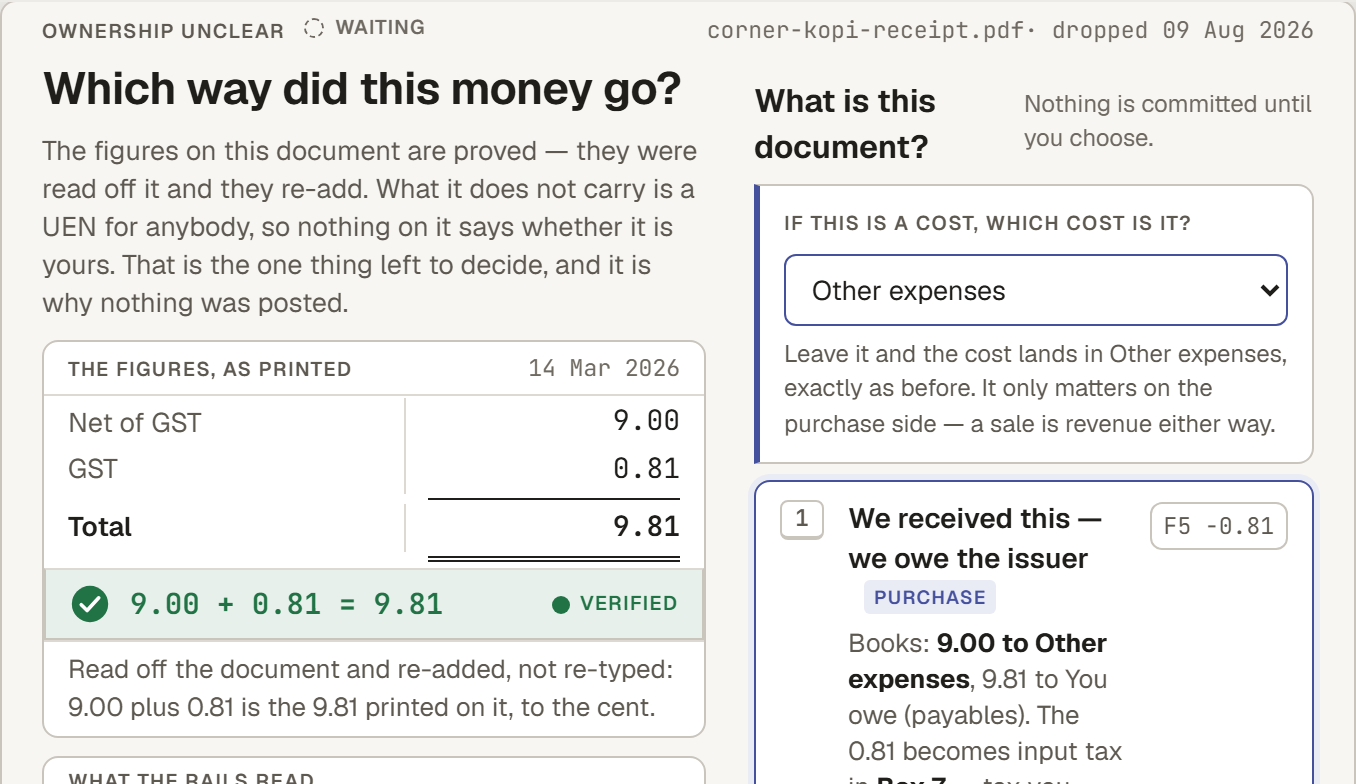
- Net of GST
- 9.00
- GST
- 0.81
- Total
- 9.81
9.00 + 0.81 = 9.81 Verified
no UEN is printed on this document
What each answer would do to your books
1purchase 9.00 to Other expenses, 9.81 to You owe
2sale the same two figures, entered the other way round
3not ours nothing posts
It becomes one question. You pick between outcomes you can already see, and the pick can be undone.
Every number is added again before it is believed. The checksum lattice.
Every figure is read off the document itself and re-added; nothing is re-typed or inferred. Clean arithmetic posts as double-entry. Anything else is held. No AI decides an amount. A photo of a receipt is read by text recognition on your own machine, and its figures must add up like any other document's.
- Peppol / InvoiceNow XML
- Bank statement CSV
- Spreadsheet (.xlsx / .ods)
- PDF invoice or receipt
- Photo of a receipt
Everything that gets held, listed
Pick the door. The figures don't move.
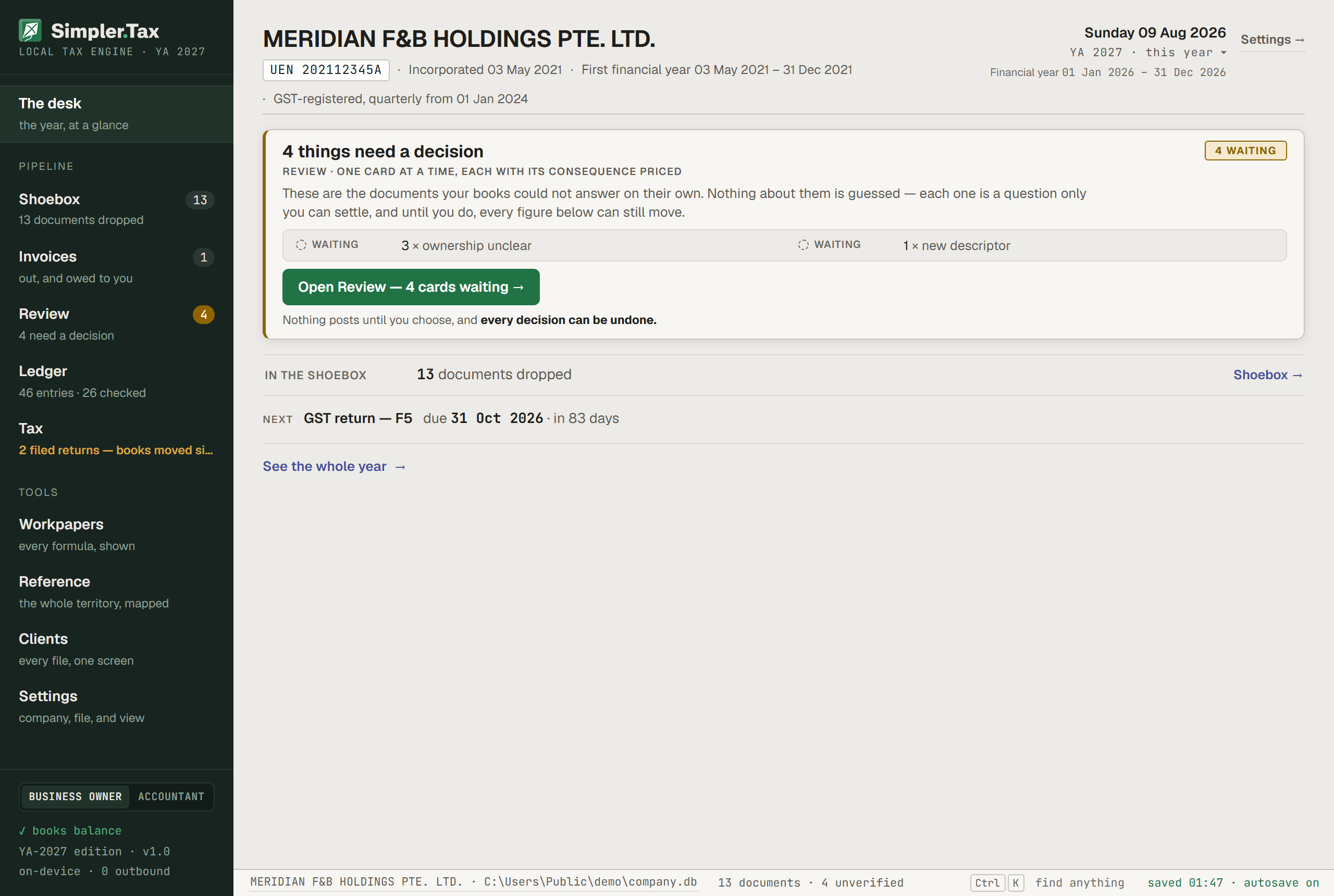
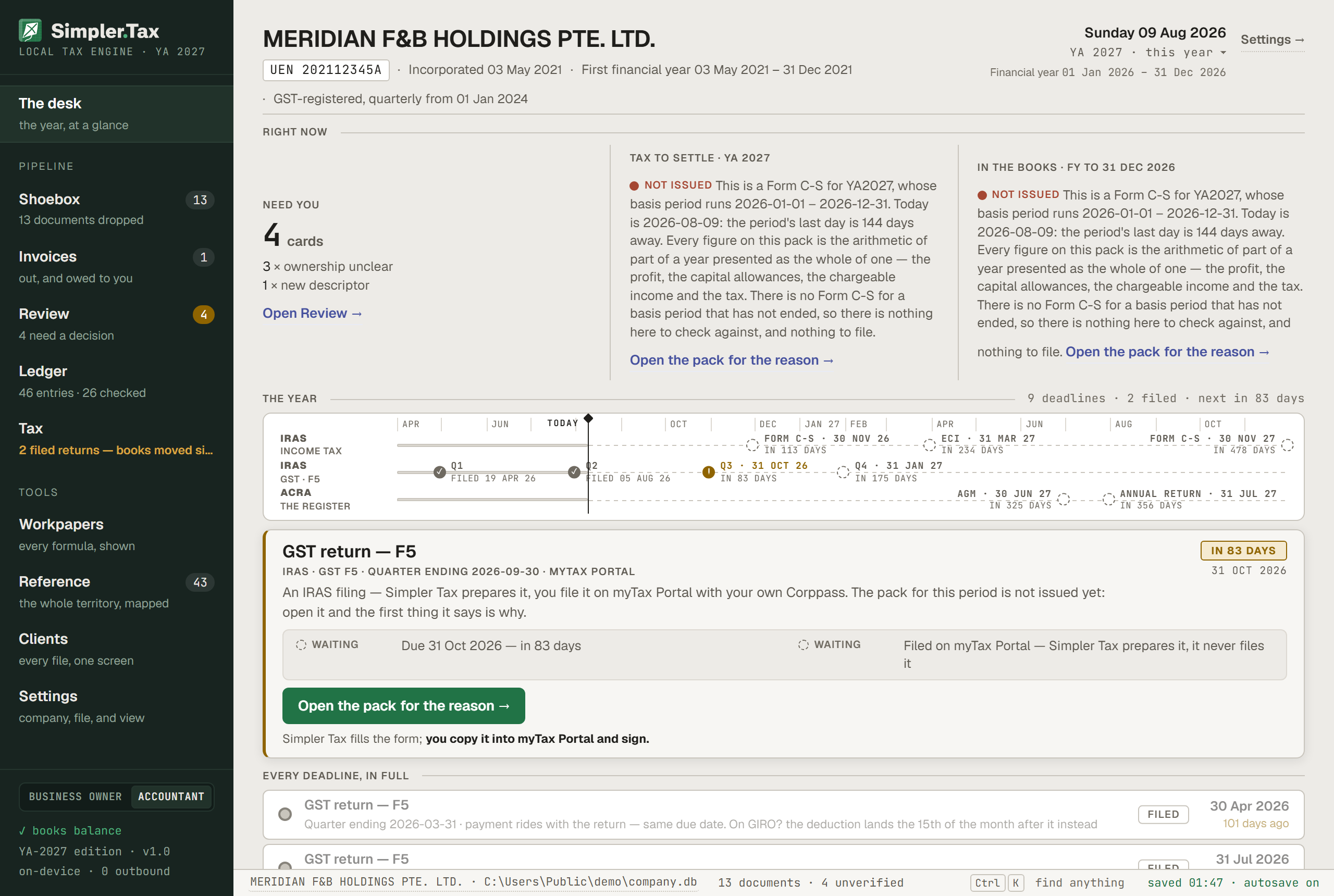
The same books, two ways: plain language priced in dollars, or standard terms and a Dr/Cr register. Not one figure changes between them. Pick a door and the page switches with it.
- Every choice priced in your own books before you make it.
- The year in one screen: what needs you, what's due, what's filed.
- One button writes the whole workbook for your accountant.
- Append-only Dr/Cr register. Corrections post reversing entries.
- Provenance on every row, back to the source document.
- One file per client · workpapers with live formulas.
The identity, re-checked after every entry
The identity holds, to the cent. The minus just means more spent than earned so far. That's what balances the books. Dr 226,033.00 = Cr 226,033.00
Flip the pill: the words trade places, not one digit moves, and a harness check fails the build if they ever do.
One file, on your machine, and a counter that proves it.
One company file you can copy, back up, or keep on an encrypted disk. We never receive your data, and we couldn't if we wanted to. Easy sentences to write, so the app measures them instead of asserting them.
You can watch it refuse.
Every network route out of the engine is wrapped. An attempt to use one gets Refused and counted in the corner of the window, a claim you can watch instead of one you take on trust.
Sixty seconds, if you'd rather check.
Block Simpler Tax in Windows Firewall, then use it. Nothing changes, not even reading a photographed receipt, because the OCR data ships in the installer.
If the file ever comes back smaller.
Snapshots at every launch and every thirty minutes. If a crash or a bad restore hands the app a smaller file, it tells you: some recent work could not be recovered. Never a quietly smaller set of books.
“If it ever reads anything but zero, something we did not intend has happened, and you will see it before we do.”
The licence, clause 6 (Network) · read it in full
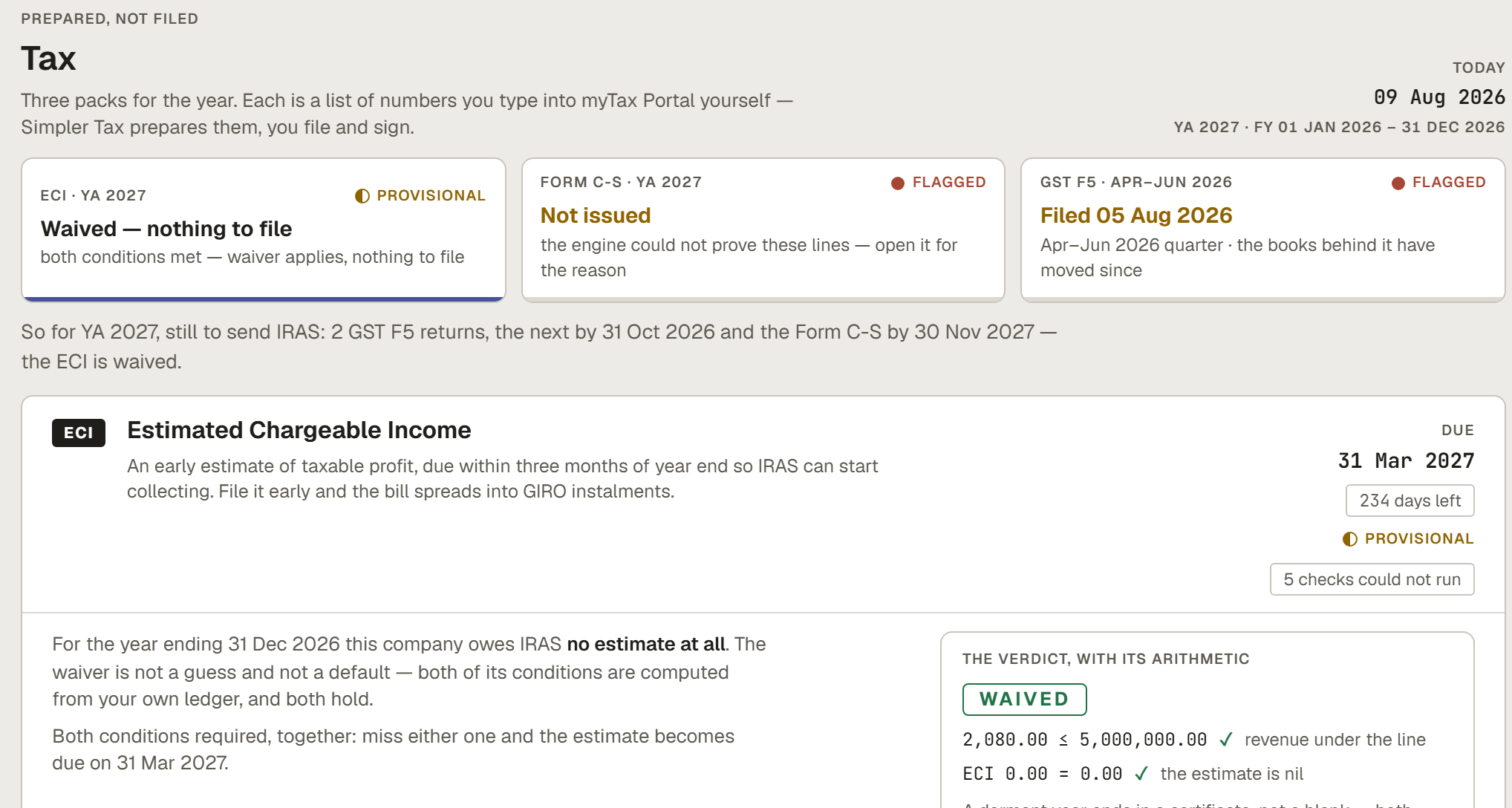
ECI, Form C-S and GST F5, filled in from your own books. ECI, Form C-S and GST F5, box by box.
Each pack is a list of numbers with a copy button on every box it computes. You type them into myTax Portal and sign. Simpler Tax files nothing and holds no Corppass credentials.
Not a private limited company?
These are private limited company returns. A sole proprietor files their own Form B, a partnership files Form P, and this app prepares neither; the bookkeeping and the GST return still work for you. It reads the entity kind off your UEN, so a sole proprietor's file is never shown a Form C-S deadline.
Each of these has a page of its own, with the rule behind it and a worked example computed from the rulebook: when the ECI is due and whether you file one, which corporate return you file and what goes in each box, the GST F5 box by box, and what InvoiceNow will require of you. The whole set, one page per question.
How we checked it, before asking you to.
A product whose whole argument is arithmetic ought to show its own.
The full accounting
The claim that it holds what it can't prove and asks you once is either true or it's this number. Of the 80 F5 returns the engine emits, 17 differ from an independent implementation of IRAS's rules, and all 17 print a hold on the cover. 54 of the 80 come back with nothing flagged, and every one of the 54 is exactly right. It was 2 in early August and 1 for most of it; both closed the same way: the engine was missing an input, and we built it. Zero is a floor to hold, not a trophy: every new lane is a new way to be silently wrong, and the corpus is run against this number before anything ships.The full accounting
140 scenarios, 98 judged box by box against the same independent implementation: 63 of 80 emitted returns are exactly right, the 17 wrong ones say so on their covers, and 18 more are refused with reasons rather than guessed. Know it before you trust a computed F5 over the review cards. Three deliberately-broken controls are excluded from both counts; they exist to prove the comparator can still see a one-cent error. A comparator that can't fail isn't checking anything.Whose paper it was
The receipts were photographed in Malaysia and Indonesia: the closest public answer-keyed paper to what a small Singapore company keeps. None of it ours. The count held at zero is the same one as above: wrong and silent.All of it from the test harness.
Four things it does not do.
All four are easier to hear from us now than to find out on your own at eleven at night.
It does not file for you.
It prepares the numbers; you file with your own Corppass and sign. It holds no credentials and has no route to myTax Portal.
It does not compute most of the GST scheme boxes.
The scheme boxes (9–12, 15–21) print a word saying whose lane each is, never a copyable figure, and a quarter with any reverse-charge purchase is refused outright rather than returned half right.
Box by box, and what the zeroes still say
F5 boxes 9–12 and 15–17 (MES imports, tourist refunds, bad-debt relief and recovery, pre-registration claims, the overseas-vendor lanes) print a word with a note saying whose lane each is — never a copyable figure. So does the IGDS section, boxes 18–21: if you are an approved Import GST Deferment Scheme importer, your deferred import GST is not in this pack and the return says so. The reverse-charge refusal exists because the claim side rides a recovery ratio this engine doesn't model, so that quarter goes to your accountant.
The zeroes are not quiet: where your own books contain evidence that one of those boxes is yours (an MES answer, a debt unpaid past twelve months, money landing on a debt you wrote off, a registration date inside this period), the return says so on its cover, names the box, and hands over what it can prove as a stated floor or ceiling rather than a figure it can't stand behind. If one of those lanes is yours, you fill it from your own permits and records, and this app will keep telling you so.
It does not control WebView2.
The window is drawn by Microsoft's WebView2, which does its own telemetry and update checks outside the app and outside its counter. Your books aren't in that traffic. If Windows has no WebView2 at all, the installer fetches Microsoft's copy once; after that, nothing.
It does not carry a publisher signature yet.
Our code-signing certificate is still being issued, and we ship honestly unsigned rather than wait for it. So Windows will warn you: “Windows protected your PC”, publisher unknown. That warning reports the absence of a certificate, not something found in the file. If you proceed (More info → Run anyway), check the download's SHA-256 against the one at the foot of this page. If it does not match, read the line beneath it before assuming the worst: this build replaced an earlier one on 11 September 2026, and a file matching that older hash is an older download, not a tampered file. The first signed build replaces this one, and this box goes with it.